Check a draft · Rewrite a draft

Your client
can tell.

They will not say anything. They will read “I wanted to reach out and provide a comprehensive update” and quietly file you under people who send AI email. You sell judgement. That is an expensive thing to give away in a sentence.

So this does two things. It shows you every phrase in your draft that gives it away, and it writes around them without moving a date, a number or a caveat you wrote.

Checking is free and unlimited, and never sends your text anywhere. Rewriting is 40 drafts a month free, no card, and none of them are stored.
1 · Check38 tells

I wanted to reach out and provide a comprehensive update on where the integration work stands. It's worth noting that the scope has proven more nuanced than initially anticipated. Moving forward, we are targeting August 28 for delivery, however that date is contingent on vendor API access, which is still outstanding. In the meantime, the team continues to leverage the staging environment to ensure a seamless handoff. Ultimately, I'm confident we can navigate the remaining challenges and deliver a robust solution within two weeks of that access landing.

Every mark is a phrase the checker found in the words — not a guess about who wrote them.

2 · Rewrite0 tells

Same date. Same condition attached to it.

one
97 terms
in 7 categories
8 sentence shapes
12 stock openers

Check

You already know these when you see them.

The writing is not bad. That is the frustrating part. It is competent and clear and it still reads like it came from somewhere else, because a handful of habits give it away every time. Paste a draft and every one of them gets named, in place, in your browser — nothing is uploaded and there is nothing to sign up for.

Vocabulary

delve · leverage · robust · seamless · myriad

Words that arrived with instruction tuning and never leave.

Antithesis

“It's not just X — it's Y.”

The shape readers notice first, and the one nobody says out loud.

Throat clearing

“It's important to note that…”

A sentence that announces itself instead of starting.

Signposting

however · moreover · furthermore · ultimately

Transitions that label a structure the reader can already see.

Rhythm

Every sentence the same length.

Measured, not guessed. Uniform pacing is the strongest signal there is.

Punctuation

— and ; past a certain density

The mark is fine. The rate is the tell.

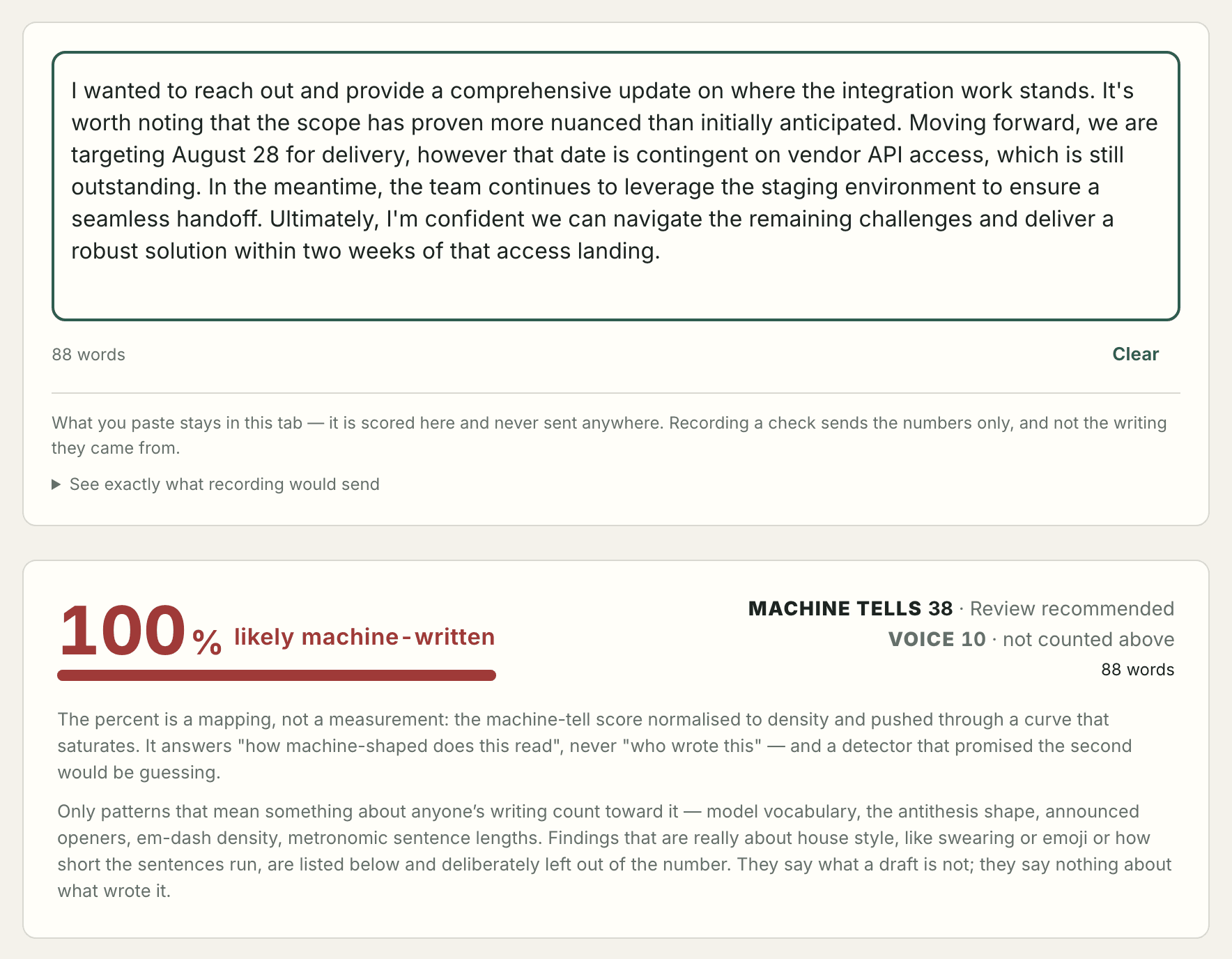
The rewr.it checker scoring a consultant's status email at 100 percent likely machine-written, with 38 machine tells counted.
The same email the hero marks up, read by the checker. It runs in your browser — the words never leave the tab.

The number counts patterns in the words. It is not a verdict about who wrote something, it is not a detector, and it is not a judgement about whether the writing is any good.

Check a draftFree, unlimited, no account.

two
3 facts
in that email
0 changed

Rewrite

It will not move your delivery date.

Most tools that promise to fix machine prose paraphrase it, and paraphrase drifts. A date moves. A hedge disappears and a maybe becomes a did. You send it, the client reads a commitment you never made, and you find out about it six weeks later.

Every claim in the output has to trace back to a specific sentence in your draft, and a sentence too tangled to keep safely stays exactly as you wrote it and gets flagged. Then the rewrite is checked against the draft before you see it — numbers, dates, names, quotes and links pulled out of both and compared. Here is that check, run on the email above:

Fact audit0 warnings
  • August 28datekept
  • 28numberkept
  • two weeksnumberkept

No missing or added numbers, dates, URLs, quotes, or names detected. August 28 is listed twice on purpose — once as a date, once as the bare number — so a rewrite that quietly drops the month still trips the check.

Where it is going changes the shape it comes back in. There are 9 of those to pick from — a Slack message is not a skip-level — and you can point it at your own writing instead, which measures your rhythm rather than guessing at it.

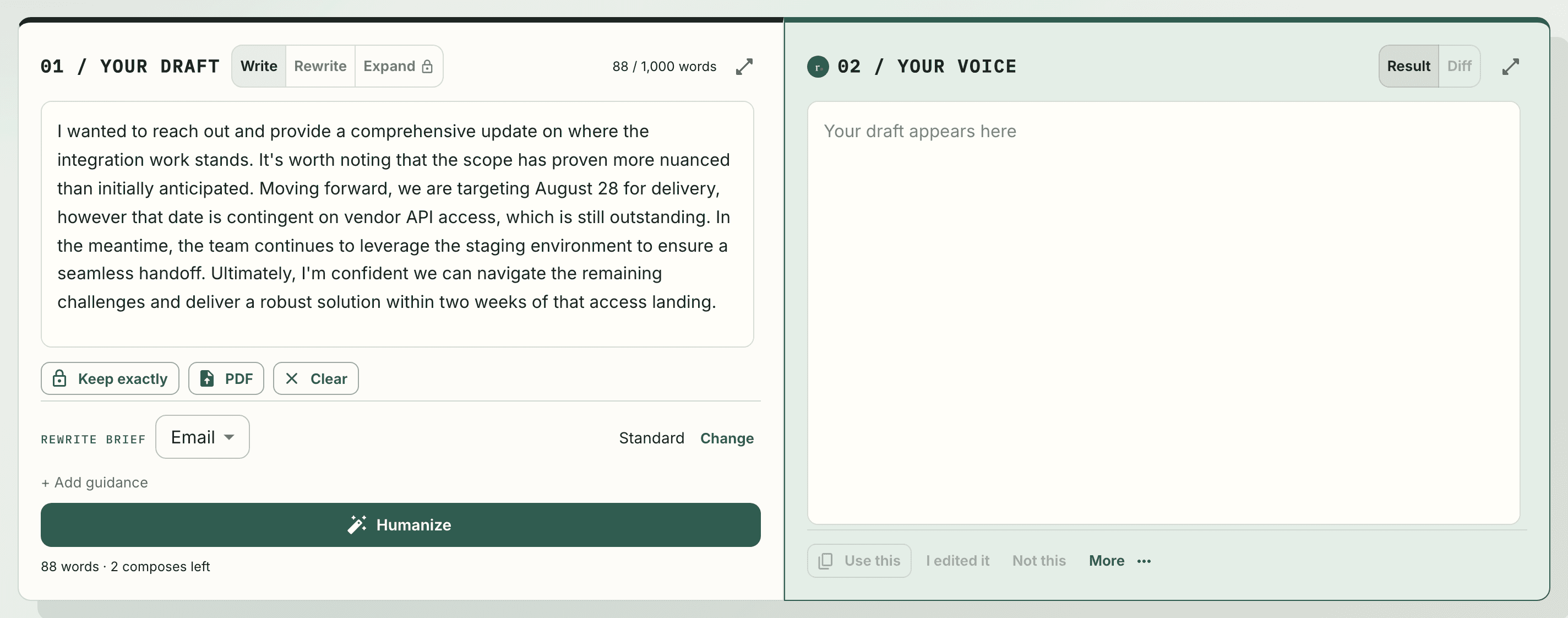
The rewr.it rewrite surface: a draft pane, the register picker, and the fact audit.
What opens when you click through. No account needed to look.

Nothing is written down. The draft goes to the model, the rewrite comes back, and there is no writing history in this product — none to leak, none to hand over, none to train on.

no seats
no annual lock

Try it on something real first.

Free

$0 / month

  • Checking, unlimited
  • 40 rewrites a month
  • Up to 2,500 words a draft

Enough to run a month of client email through it before you decide anything.

Pro

$10 / month

  • 150 rewrites a month
  • Up to 5,000 words a draft
  • Your own document types and saved voice
  • API keys and the faster model

For the week where it is open every day. Less than one billable six minutes.

See what Pro includes →

Past that

$2 and up

  • Credits, bought once
  • They do not expire
  • Only spent on what you run

For the month with the proposal in it.

How credits work →

the awkward ones

Fair questions.

Will it change what I said?

No. Every claim in the output has to trace to a sentence in your draft, and a sentence that cannot be preserved safely is kept and flagged rather than smoothed over. Then the rewrite is audited against the draft — numbers, dates, names, quotes, links — and the warnings are on screen before you copy anything. That constraint sits in front of everything else the rewriter is told.

Can I put client email through it?

Your drafts are not stored. The text goes to the model, the rewrite comes back, and the draft is gone: there is no draft history in this product, so there is none to leak and none to hand over. The rewrite itself is kept encrypted for thirty days so that asking twice gives you the same answer, and it deletes itself. Whether that clears your own client agreement is a call only you can make, and it is worth making before you paste something covered by one.

Does it sound like me?

It can. Paste a few things you have written and it measures your rhythm — how long your sentences run, how much that varies, how often you run short — then shapes rewrites to those numbers rather than to the default voice. That measuring happens in your browser and needs no account. What it does not do yet is pick up your vocabulary, so out of the box it sounds like you in shape and like one considered voice in word choice.

Will this beat an AI detector?

That is not the promise, and anyone making it is guessing. Detectors change weekly and any text can be edited past one, including by this. What you get is prose that stopped carrying the marks — which is the part an actual reader notices, and the part you were worried about anyway.
The thinking was always yours.
The words should be too.